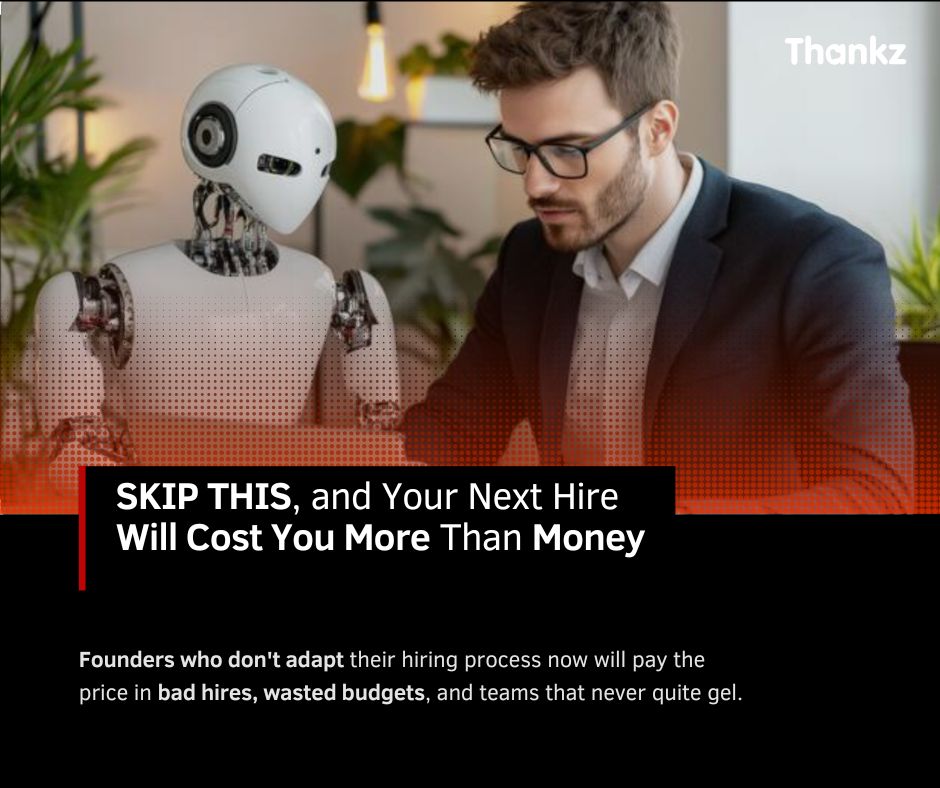
By 2028, 1 in 4 candidate profiles worldwide could be fake. Founders who don’t adapt their hiring process now will pay the price - in bad hires, wasted budgets, and teams that never quite gel. Here’s what’s happening, why it matters, and how the smartest companies are already responding.
Something changed in hiring this year - and most founders haven’t noticed yet.
The number of applications per job posting has exploded. Candidate profiles look more polished than ever. Resumes are perfectly tailored. Interview answers are sharp and articulate. And yet, hiring teams across the US are reporting a growing problem: the person they’re interviewing isn’t always who they say they are.
Welcome to the AI hiring crisis - the single most underreported threat to your team-building efforts in 2026.
86%
of recruiters have caught or suspected candidate fraud in the past 12 months.
Source: Greenhouse 2026 AI Hiring Report
What’s actually happening
Generative AI has made it trivially easy to fabricate a compelling candidate. Tools that used to require a professional resume writer, a good memory, and a lot of nerve now take about 10 minutes and $0.
Here’s what hiring managers are up against right now:
- AI-generated resumes - perfectly tailored to your job description with plausible metrics, industry vocabulary, and ATS-passing formatting
- Deepfake video interviews where a different person’s face is rendered over the real applicant’s
- Proxy interviewers - someone else entirely answering questions while the “candidate” listens on earpiece
- Synthetic identities built from leaked personal data and AI-generated credentials
- Ghost workers who use AI agents to automate their actual work output after being hired
This isn’t hypothetical. According to Greenhouse’s 2026 AI Hiring Report, 91% of recruiters and hiring managers have spotted or suspected candidate deception - and 74% say they’re more worried about fake credentials than they were just a year ago.
1 in 4
candidate profiles worldwide are projected to be fake by 2028.
Source: Gartner, Top Trends for Talent Acquisition 2026
Why AI-generated hiring doesn’t catch AI-generated candidates
Here’s the uncomfortable irony: the same companies racing to automate their hiring with AI are the most vulnerable to AI-enabled fraud.
When your entire top-of-funnel is automated - AI sourcing, ATS screening, automated scheduling, AI-scored assessments - you’ve built a pipeline that’s optimised to process volume, not verify authenticity. And AI-generated applications are built specifically to pass those automated checkpoints.
AI generates applications. Humans build great teams. The best hiring processes use both - but in the right order.
According to SHRM’s State of AI in HR 2026 report, 19% of organizations using automation in hiring say their tools accidentally screen out qualified applicants - while doing almost nothing to screen out fraudulent ones. Background checks, which most companies rely on as their verification layer, only confirm that fraudulent credentials hold up. They can’t tell you whether the person being evaluated is the same person who applied.
Only 19% of hiring managers say they’re extremely confident their current process would catch a fraudulent applicant.
This is the gap that human-curated recruitment was built to fill.
The case for human-curated vetting
At Thankz, we’ve spent 13 years building a vetting process that no algorithm can replicate - because we built it before AI existed, and we’ve refined it specifically because AI can’t do what we do.
When we present a candidate, we’ve already done the work that automated tools skip:
Multi-stage human verification
Every candidate goes through structured video interviews, competency assessments, and reference checks conducted by human recruiters - not AI scorers. We’re looking for signals that a chatbot can’t fake: how someone thinks through a problem, how they communicate uncertainty, how they handle unexpected questions.
Cultural and contextual fit assessment
The strongest hires aren’t just technically capable - they’re a fit for how your company actually operates. We assess for work style, communication preferences, autonomy tolerance, and remote collaboration readiness. These are things you can’t score with a resume parser.
Ongoing relationship with the talent pool
Because we source from 17 countries and maintain long-term relationships with talent in each market, we know our candidates as people - not just profiles. That context is irreplaceable. A fraudulent candidate doesn’t have a history with us.
Post-placement accountability
Our 73% six-month retention rate isn’t an accident. We stay involved after day one because we know the risk of a bad hire doesn’t disappear at the offer letter. That ongoing relationship is what separates a placement agency from a hiring partner.
73%
of Thankz-placed hires are still with their clients after 6 months.
Source: Thankz internal data, 2026
What this means for founders building global teams
If you’re hiring remotely - and in 2026, most growth-stage founders are - the AI fraud problem hits harder. Remote hiring lowered the barrier to impersonation. You can’t rely on a physical office interview. You can’t read body language across a video call with the same confidence. And if your candidate is in a different country, verification gets even more complex.
This is exactly why global remote hiring benefits most from a human-in-the-loop approach. The answer isn’t to hire less globally - global talent is still the single biggest competitive advantage available to US-based founders. The answer is to hire smarter.
The best global talent isn’t just cheaper - it’s exceptional. But finding it requires a process that AI can’t shortcut.